
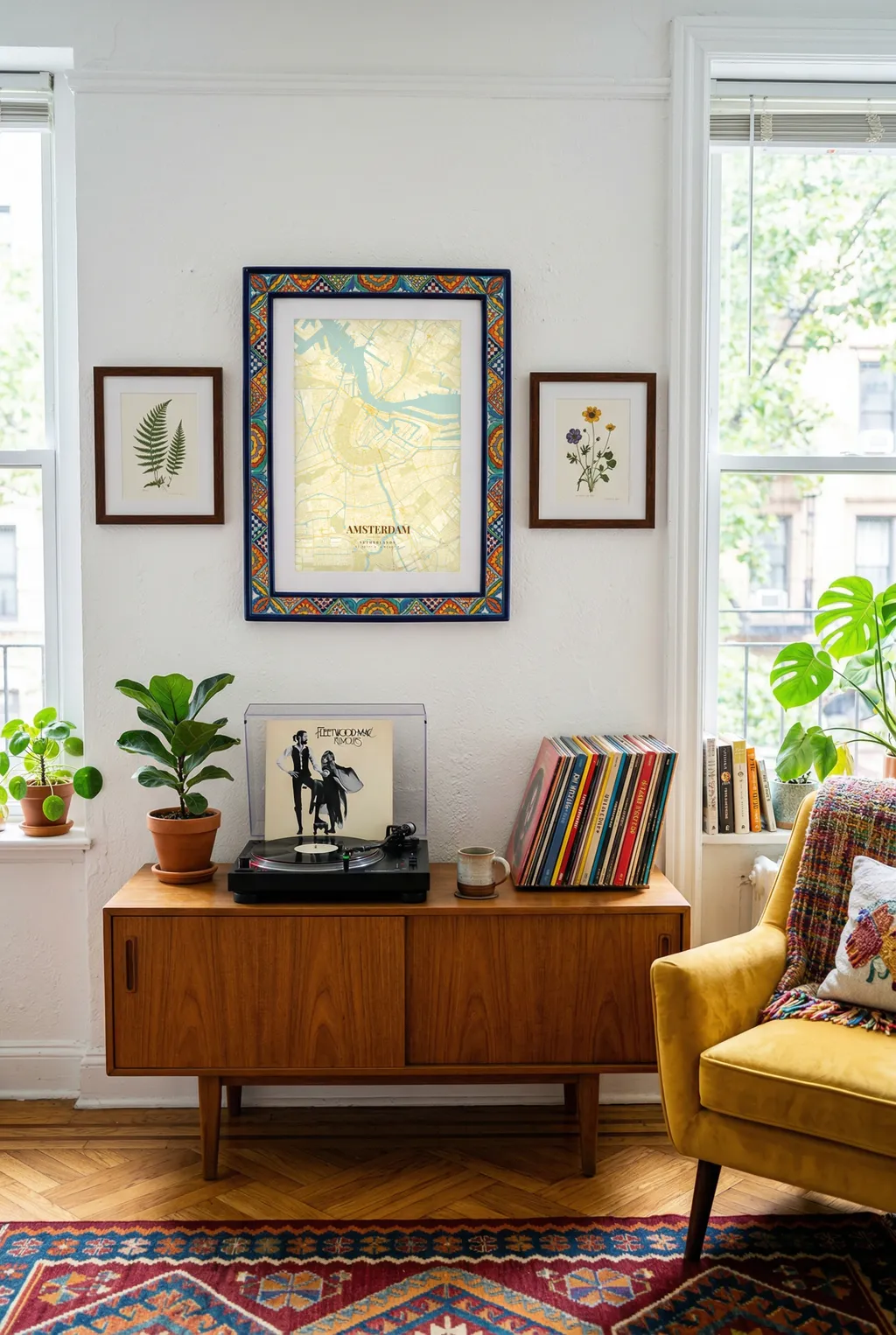
How to Build a Gallery Wall with Map Posters: Layout Ideas, Sizing, and Styling Tips
A gallery wall turns a blank stretch of drywall into the most interesting thing in the room. And while family photos and abstract prints are the usual suspects, map posters bring something different to the mix — a sense of place, personal history, and graphic precision that pairs well with almost any interior style.
This guide walks through how to plan, lay out, and hang a gallery wall that features custom map posters, whether as the centrepiece or woven in alongside other artwork.
Why Map Posters Work So Well on Gallery Walls
Most gallery walls struggle with coherence. You end up with a random assortment of prints that looked great individually but feel disjointed together. Map posters solve this naturally because they share a visual language — clean lines, geographic shapes, consistent typography — while each one tells a different story.
A map of the city where you grew up next to the city where you live now. Your honeymoon destination beside the town where you got married. Three cities from a backpacking trip across Europe. The visual consistency of map art holds the wall together while the locations make it personal.
Choosing Your Layout Style
Before you pick up a hammer, decide on a layout. The right one depends on your wall space, the number of pieces, and the look you're going for.
The Grid
A symmetrical grid is the cleanest option. Works best with 4, 6, or 9 pieces in identical frames. For map posters, this is especially striking — imagine a 3x3 grid of cities you've visited, all in the same minimalist black-and-white theme. The repetition of the map style creates rhythm, while the different street patterns give each piece its own character.
Best for: Modern and Scandinavian interiors, hallways, home offices.
The Salon Style
The salon style (also called "Petersburg hang") is a collected, organic arrangement where frames of different sizes overlap in a loose cluster. It feels curated and lived-in. Mix large map posters with smaller prints, photographs, or even a small mirror.
Best for: Living rooms, eclectic spaces, maximalist decor.
The Horizontal Line
Three to five pieces hung in a single horizontal row at eye level. Simple, elegant, and hard to get wrong. This works beautifully above a sofa or along a dining room wall. Choose maps of similar dimensions and use consistent spacing.
Best for: Above furniture, narrow walls, minimalist interiors.
The Statement Piece Plus Satellites
Start with one large map poster (A1 or 24x36 inches) as the anchor, then surround it with 3-5 smaller pieces. The large piece does the heavy lifting while the satellites add context. For example, a large map of London in the centre, flanked by smaller maps of specific neighbourhoods — Shoreditch, Camden, Notting Hill.
Best for: Feature walls, bedrooms, large open-plan spaces.
How to Pick the Right Sizes
Size matters more than most people think. A common mistake is hanging pieces that are too small for the wall — they end up looking like postage stamps floating in space.
General rules:
- Above a sofa or bed: The gallery wall should span roughly two-thirds the width of the furniture below it.
- Narrow hallway: Stick to a vertical stack or single column of 3-4 pieces.
- Large feature wall: Go big. At least one piece should be A2 (16.5 x 23.4 inches) or larger.
- Small room: Fewer, larger pieces feel more intentional than many small ones.
For map posters specifically, mixing portrait and landscape orientations adds visual interest. A portrait-oriented city centre map next to a landscape coastal view creates natural contrast.
Picking a Colour Theme
This is where map posters really shine. Because you can customise every colour on a map poster — roads, water, parks, background, text — you can design an entire gallery wall with a unified palette.
Popular approaches:
- Monochrome: All maps in black, white, and grey. Timeless, works with any decor, and lets the street patterns take centre stage.
- Warm neutrals: Cream backgrounds with soft terracotta roads and muted greens. Perfect for Scandinavian or boho interiors.
- Navy and gold: Dark navy backgrounds with gold or white line work. Dramatic and sophisticated — works well in home offices and bedrooms.
- Mixed themes, same palette: Use different MapPoster themes (Classic, Vintage, Watercolour) but keep the same two or three base colours across all of them. This creates variety in texture while maintaining cohesion.
Spacing and Hanging Height
Two numbers to remember:
- 5-7 cm (2-3 inches) between frames. This is tight enough to read as a group, but loose enough that each piece breathes. For grids, keep spacing perfectly even. For salon style, you can vary it slightly.
- 145 cm (57 inches) from floor to centre of the arrangement. This is standard gallery hanging height — roughly eye level for a standing adult. If the wall is above a sofa, lower it so the bottom of the lowest frame sits 15-20 cm (6-8 inches) above the furniture.
Pro tip: Before drilling any holes, cut pieces of paper to the size of each frame and tape them to the wall. Step back, take a photo, rearrange. This five-minute step saves a lot of regret and plaster filler.
Framing Your Map Posters
The frame makes or breaks a gallery wall. Here's what works:
- Matching frames: Identical frames in the same colour and profile give a polished, intentional look. Best for grids and horizontal rows.
- Mixed frames: Different frame styles and colours create a collected-over-time feel. Works for salon layouts. Stick to a maximum of 2-3 frame colours to avoid chaos.
- Frameless: Mounting map posters on foam board or simply clipping them with poster rails gives a modern, lightweight look. Great for renters who can't drill too many holes.
For map posters, thin black or natural wood frames are the most versatile. They don't compete with the detail of the map, and they work in nearly every interior style.
Five Gallery Wall Ideas Using Map Posters
1. The Travel Timeline
Choose maps of every city you've lived in or visited, arranged chronologically from left to right. Add the year as a subtitle on each poster. This becomes a visual autobiography on your wall.
2. The Love Story
Three posters: where you met, where you got engaged, and where you got married. Or: their hometown, your hometown, and the city where you built a life together. Frame them identically and hang in a row.
3. The Dream Destinations
A grid of places you haven't been yet but plan to visit. Tokyo, Reykjavik, Cape Town, Patagonia. Use a consistent warm theme and let the wall serve as inspiration — then update it as you check places off.
4. The Neighbourhood Deep-Dive
One large city-wide map surrounded by zoomed-in maps of your favourite neighbourhoods. This works especially well for cities with distinctive districts — New York, London, Paris, Tokyo.
5. The Family Roots
Map each family member's birthplace, hometown, or favourite city. Include grandparents' hometowns for a multigenerational story. This makes a meaningful centrepiece for a family room or hallway.
How to Print and Display
Once you've designed your map posters, download them in the highest resolution available. For gallery walls, sharpness matters because viewers will stand close and examine the details.
- Paper choice: Matte or lustre photo paper gives the best results for map art. Glossy paper can create glare under living room lighting.
- Print sizes: Match your frames. Standard sizes (A4, A3, A2, 8x10, 11x14, 16x20, 18x24) are easier to find frames for.
- Online print services: Upload your file to any online printing service. Most offer framing options too.
Final Thoughts
A gallery wall is one of the few home decor projects where the result is genuinely unique to you. Nobody else has your combination of cities, memories, and places. Map posters give you a way to put all of that on display with a visual style that's cohesive, personal, and — frankly — looks really good on a wall.